
Updated October 19, 2026. Black Friday is November 27 and Cyber Monday is November 30.
“70% off” banners are everywhere from now until Cyber Monday. Some of those furniture discounts are real. Others are fake furniture sales: a made-up “was” price next to the price the item has sold for all year.
A sofa or bed frame is a big purchase, so it’s worth five minutes to check. Here’s how to spot fake furniture sales, what a real deal looks like, and what to do if a sale turns out to be misleading.
How we put this together: we read the FTC’s pricing guidance and the retailer policies we cite, and we checked them on the dates shown. We don’t test furniture in person. See how we review furniture.
Quick Answer: How to Spot Fake Furniture Sales
- Check the price history. What did the item actually sell for in the last few weeks?
- Ignore “compare at” and list prices. They aren’t proof that anyone paid that price.
- Match the exact model number, size and color before you compare stores.
- Add delivery, assembly and return costs to the sale price.
- Read “up to” carefully and check the discount on the item you want.
What Makes a Furniture Sale “Fake”?
Most fake furniture sales don’t lie about today’s price. They lie about the old price. If a dresser is marked “Was $899, now $449” but it has sold for $449 for months, the discount is fiction.
The FTC’s Guides Against Deceptive Pricing describe this directly. A former price used in a sale should be the actual price the item was openly offered at, on a regular basis, for a reasonably substantial period of time. A price that was set high only so it could be “cut” is what the guides call a fictitious former price.
Those guides explain how the FTC looks at pricing claims; they aren’t a promise that every store follows them. That’s why your own checks matter.
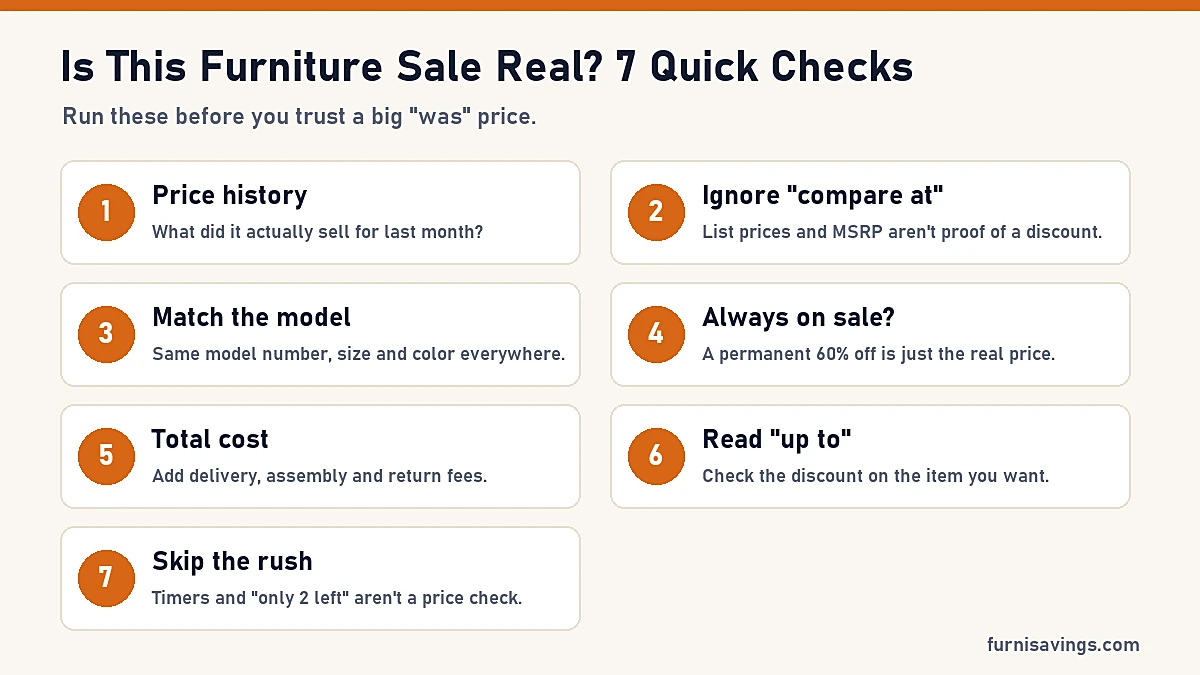
7 Ways to Spot Fake Furniture Sales
1. Check the price history
This is the single best test. For Amazon listings, free price trackers such as CamelCamelCamel and Keepa show a product’s past prices. For other stores, save the product page or take a screenshot now, then compare it on Black Friday. If the “sale” price matches what it cost three weeks ago, it isn’t a sale. Price history catches most fake furniture sales in seconds.
2. Ignore “compare at” and list prices
“Compare at,” “MSRP” and “list price” tell you what someone suggested, not what shoppers paid. A real discount is measured against the price the item actually sold for. Treat a big gap between a list price and a sale price as a reason to check, not a reason to buy.
3. Match the exact model
Furniture often comes in many sizes, colors and fabric grades, and some stores sell their own versions with a different model number. Compare the same model number, dimensions and finish across stores. Otherwise you may be comparing a cheaper version to a pricier one.
4. Watch for the “always on sale” store
If a store or listing shows 50% to 70% off every time you look, that discount is the normal price. A real sale has a start and an end, and the price goes back up afterward. Stores that are always on sale are one of the most common sources of fake furniture sales, and price history (check #1) shows this quickly.

5. Add up the total cost
Furniture deals can hide costs in delivery, white-glove setup, assembly and returns. A sofa that’s $100 cheaper isn’t a deal if delivery costs $150 more. Read the return policy too: sale items are often final sale. For example, when we checked Sohnne‘s policy in October 2026, sale and promo items were final sale, and full-price returns carried a 20% restocking fee plus return shipping.
6. Read “up to” carefully
“Up to 60% off sofas” can mean one sofa in one color is 60% off and the rest are 10% off. Open the item you actually want and check its own discount, size and color.
7. Don’t let a timer decide for you
Countdown clocks and “only 2 left” messages create pressure, not proof. If the price is real, it will still look good after you’ve checked the price history and the total cost.
Fake Furniture Sales vs. Real Deals
Use this side-by-side to sort fake furniture sales from real ones:
| Sign of a fake sale | What a real deal looks like |
|---|---|
| Huge “was” price the item never sold at | Price drop from what shoppers actually paid recently |
| Always 50–70% off | Sale has clear start and end dates |
| “Up to” headline, small discount on your item | Discount shown on the exact item, size and color |
| Low price, high delivery or setup fee | Low total cost, including delivery and returns |
| Timer or “almost gone” pressure | Same price whether you buy today or tomorrow |
Black Friday can still be a good time to buy furniture. Read whether Black Friday is the best time to buy furniture, and see when last year’s sales started in our Black Friday furniture deals guide.
What to Do About Fake Furniture Sales
- Keep screenshots of the product page, the price and the date.
- Ask the store for a price adjustment if the price drops after you buy. Many stores have a price adjustment window, so check its policy.
- Use the return window if the item isn’t what the listing promised. Check for fees first.
- Report it. You can report deceptive pricing to the FTC at ReportFraud.ftc.gov.
The best defense against fake furniture sales is time. Start tracking the pieces you want now, so you’ll know a real price drop when you see one. Our best time to buy furniture calendar shows when prices usually fall.
Frequently Asked Questions
Not all of them. Many Black Friday furniture discounts are real, but some fake furniture sales compare today’s price to a “was” price the item rarely sold at. Check the price history before you buy.
For Amazon listings, free trackers such as CamelCamelCamel and Keepa show past prices. For other stores, save screenshots of the product page now and compare them on sale day.
Not necessarily. A “compare at” or list price is a suggested price. A real discount is measured against what the item actually sold for.
The FTC’s Guides Against Deceptive Pricing say a former price used in a sale should be the actual price the item was openly offered at for a reasonably substantial period. A price inflated only to be “cut” is a fictitious former price.
You can report deceptive pricing to the FTC at ReportFraud.ftc.gov. Keep screenshots of the listing, the price and the date.
More Furniture Deal Guides
- Black Friday sofa deals: sectionals, sleepers and recliners.
- Holiday furniture deals: order in time for Christmas.
- Signs of a low-quality sofa: what a low price can hide.
- Best Amazon sofa deals this week.

Nayyar SK writes and updates the furniture reviews and buying guides on FurniSavings, covering sofas, bedroom sets, outdoor furniture and storage. Reviews are research-based, using product specs, verified-buyer reviews and current prices. See how we review furniture.