
Updated October 22, 2026.
You sit down and keep sinking. Sagging couch cushions are one of the most common sofa complaints, and they usually show up long before the rest of the couch is worn out.
The good news: many sagging couches can be fixed for far less than a new one. The trick is finding which layer is failing first. Here’s a quick test, 7 fixes from easiest to hardest, and how to tell when it’s time to replace the couch.
How we put this together: we read the foam industry’s published guidance cited below and checked Amazon’s sofa best-seller list. We don’t test furniture in person. See how we review furniture.
Quick Answer: How to Fix Sagging Couch Cushions
- Flat cushion, firm seat deck: rotate, refill or replace the cushion foam.
- Cushions fine, seat deck dips: add a support board, or fix the webbing or springs.
- Frame creaks, wobbles or is cracked: call an upholsterer, check the warranty, or replace the couch.
- Buying new foam? Ask for the density. Foam of 1.8 pounds per cubic foot (pcf) or higher is the seating benchmark the foam industry points to.
First, Find Out Why Your Couch Is Sagging
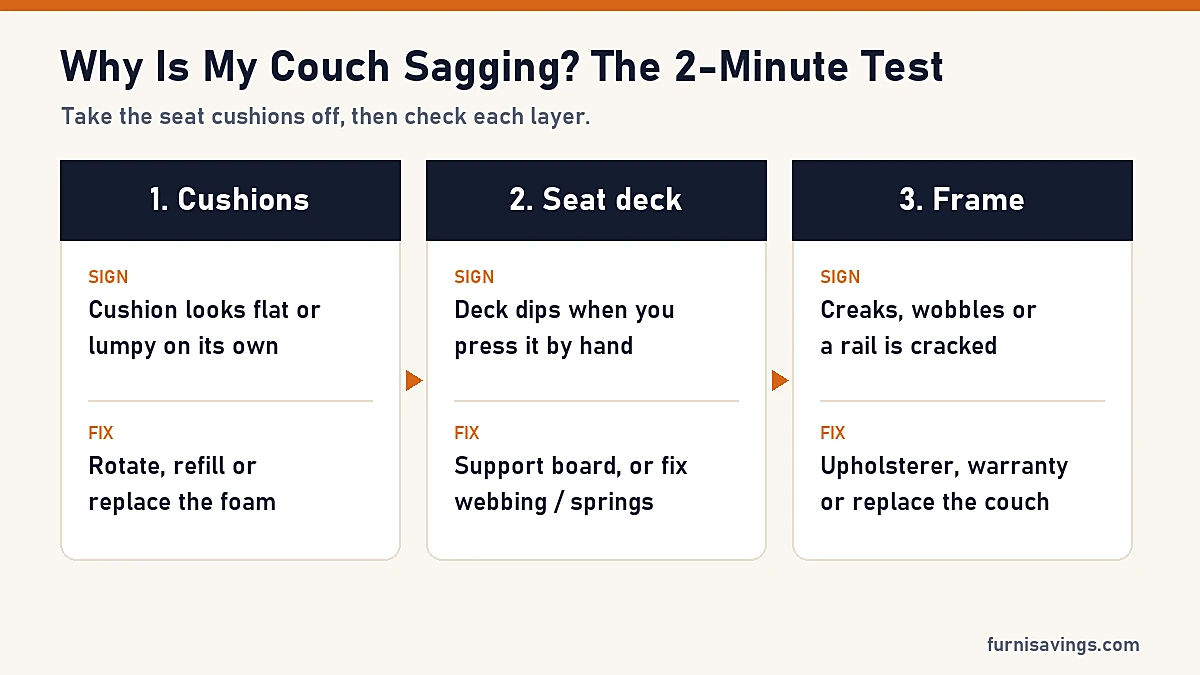
A couch has three layers that can sag: the cushions, the seat deck under them, and the frame that holds it all up. Fixing the wrong layer wastes money, so take two minutes to check.
Take the sagging couch cushions off the seat. Look at each cushion on its own: is it flat, lumpy or thinner in the middle? Then press down on the bare seat deck with your hand. If one spot dips much more than the rest, the support under the cushions is the problem. Finally, rock the couch gently and listen for creaks or cracks in the frame.
7 Ways to Fix Sagging Couch Cushions
1. Flip and rotate the cushions
If your cushions are reversible, flip them and swap their places. The seat you use most wears fastest, so rotating spreads that wear out. It won’t bring back crushed foam, but it’s free and it helps sagging couch cushions that are only starting to go flat. Make it a habit every few weeks.
2. Fluff and refill fiber-filled cushions
Not all sagging couch cushions are foam. Back cushions and some seat cushions are filled with loose fiber or feathers that clump over time. Unzip the cover, break up the clumps by hand, and add polyester fiberfill where the cushion has gone thin. Many foam cushions are also wrapped in a layer of polyester batting, and adding a fresh layer of batting can make a tired cushion look full again.
3. Add a foam topper inside the cover
For sagging couch cushions that are only slightly flat, a thin layer of new foam inside the cover, on top of the old foam, can restore height. It’s a quick fix, but the old foam underneath keeps breaking down, so think of it as a way to buy time.
4. Replace the cushion foam
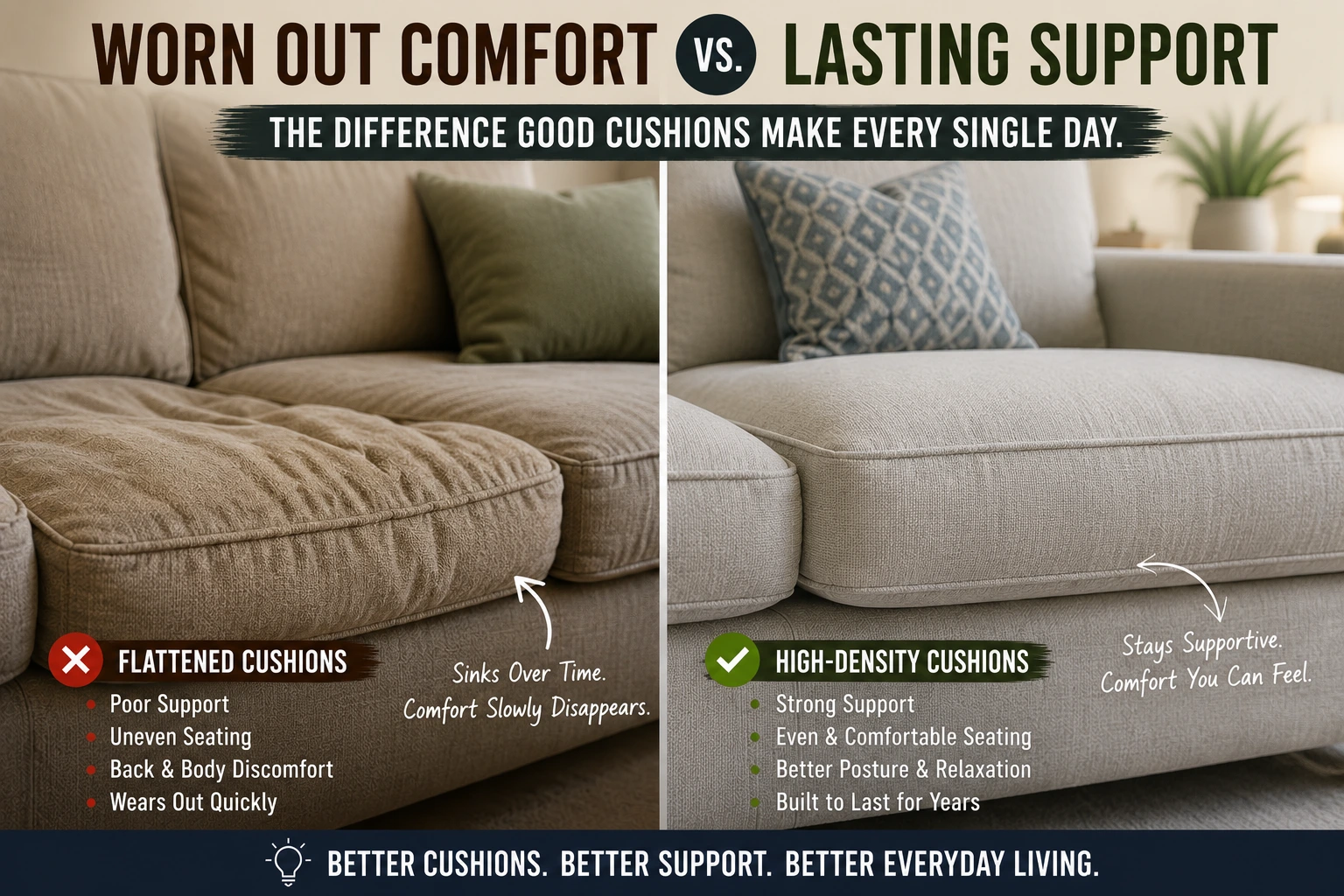
New foam is the real fix for sagging couch cushions when the foam itself is worn out. You can order foam cut to size from upholstery foam suppliers, or ask a local upholsterer to do it. Before you buy, ask two questions: what is the density, and what is the firmness?
According to the Polyurethane Foam Association, foam density is measured in pounds per cubic foot (pcf), and higher-density foams typically offer better support and durability. Density is not the same as firmness: high-density foam can be made soft, and low-density foam can be made firm. Firmness is measured separately, as IFD (indentation force deflection).
For seat cushions, a joint industry foam committee concluded that foams with a polymer density of 1.8 pcf or higher perform better in seating than lower-density foams. Its testing also found that all foams lose some firmness with use, and lower-density foams lose more. That’s why sagging couch cushions are so common on sofas made with cheap, low-density foam.
5. Slide a support board under the cushions
If the cushions are fine but the seat deck dips, a cushion support board can help. These are firm panels that slide under the seat cushions and spread your weight over the sagging area. They’re popular: on October 16, 2026, the GORILLA GRIP couch cushion support board was #14 on Amazon’s sofa best-seller list, with more ratings than any sofa in the top 10.

- ADD STRONG, LONG LASTING SUPPORT TO COUCHES AND SOFAS: easily and quickly upgrade your sagging couch or sofa with our ul…
- ULTRA DURABLE .43 INCH THICK PLYWOOD BOARDS: unlike other couch support options that use MDF or particle board, ours is …
- STAY IN PLACE GRIP DOTS: designed to stay in place on sofas, this under couch cushion support features hundreds of slip …
A board fixes support, not foam. If your sagging couch cushions are crushed flat, a board under them won’t make them comfortable again, so check the cushions first.
6. Use a plywood panel
A DIY version of the support board is a piece of plywood cut to the size of the seat deck. Sand the edges and wrap it in fabric or felt so it doesn’t scratch or snag the deck. It’s firmer than most ready-made boards, which some people like and others don’t.
7. Repair the webbing, springs or frame
Many sofas sit on either S-shaped (sinuous) springs or stretchy elastic webbing. Webbing can stretch out, and spring clips can break or come loose. Re-tightening or replacing webbing is a DIY job for a confident beginner. Broken springs or a cracked frame rail are usually a job for an upholsterer.
Check your warranty first. Some brands cover the frame, springs and cushions for different lengths of time, and a repair you do yourself may void it.
Fix It or Replace It?
Use this table to decide whether your sagging couch cushions are worth fixing:
| What you find | Usually worth fixing? |
|---|---|
| Flat cushions, solid frame | Yes: refill or replace the foam |
| Seat deck dips, solid frame | Yes: support board or new webbing / springs |
| Cracked or wobbly frame | Often not, unless the couch is high quality or under warranty |
| Sagging plus torn fabric and odors | Usually time to replace |
If you do replace it, look for the signs of a well-made sofa: a solid frame, a clear foam density spec and a real warranty. Our guide to signs of a low-quality sofa shows what to avoid, and how long a good sofa should last tells you whether yours is near the end anyway.
Timing matters too. Black Friday and Cyber Monday are coming, so see the best time to buy a sofa and this year’s Black Friday sofa deals before you pay full price.
Frequently Asked Questions
Most sagging couch cushions come from foam that has lost firmness with use. Foam industry testing found that all foams lose some firmness, and lower-density foams lose more. Sagging can also come from stretched webbing or broken springs under the cushions.
Often, yes. Rotating cushions, refilling fiber-filled cushions or adding a thin foam layer can help cushions that are only slightly flat. Crushed foam usually needs to be replaced.
They help when the seat deck under the cushions dips, by spreading your weight across the sagging area. They don’t fix foam that’s already crushed flat.
A joint foam and furniture industry committee concluded that foams with a polymer density of 1.8 pounds per cubic foot or higher perform better in seating. Density is separate from firmness, so ask for both.
Replacing usually makes more sense when the frame is cracked or wobbly, or when the couch also has torn fabric, odors or broken springs on top of the sagging.
More Sofa Guides
- Ultimate sofa buying guide: frames, foam and fabric explained.
- Best-selling sofas on Amazon right now.
- Best sofa fabric for pets and kids.
- How to spot fake furniture sales before Black Friday.

Nayyar SK writes and updates the furniture reviews and buying guides on FurniSavings, covering sofas, bedroom sets, outdoor furniture and storage. Reviews are research-based, using product specs, verified-buyer reviews and current prices. See how we review furniture.