Updated October 23, 2026.
The delivery team is at the door, the couch is in the hallway, and it’s stuck. If your couch won’t fit through the door, you’re not alone: it’s one of the most common problems with buying a sofa, especially online, where you never see it in person before it arrives.
Here’s how to measure so it doesn’t happen, the one number most people miss, and 8 fixes to try if your couch won’t fit.
How we put this together: we used published retailer measuring guidance, linked below. We don’t test furniture in person. See how we review furniture.
Quick Answer: What to Do If Your Couch Won’t Fit
- Measure the couch’s diagonal depth. It must be less than the door width for the couch to tip through.
- Take the legs off. On most couches they unscrew and give you a few extra inches.
- Take the door off its hinges to open up the full frame.
- Try another route: a patio door, back door or garage is often wider.
- Still stuck? Ask about a return or exchange, or choose a modular or boxed couch that comes in pieces.
Why a Couch Won’t Fit Through the Door
When a couch won’t fit, width is rarely the real issue. Most couches are wider than a doorway, so they never go through flat. Movers tip them on their side or on end and swing them through at an angle. Whether that works depends on a measurement most product pages don’t show up front: the diagonal depth.
The other culprits are the route, not the door: a tight turn from a hallway into a room, a stair landing, a low ceiling light or a narrow elevator. A couch that clears the front door can still get stuck at the first corner.
How to Measure Before You Buy
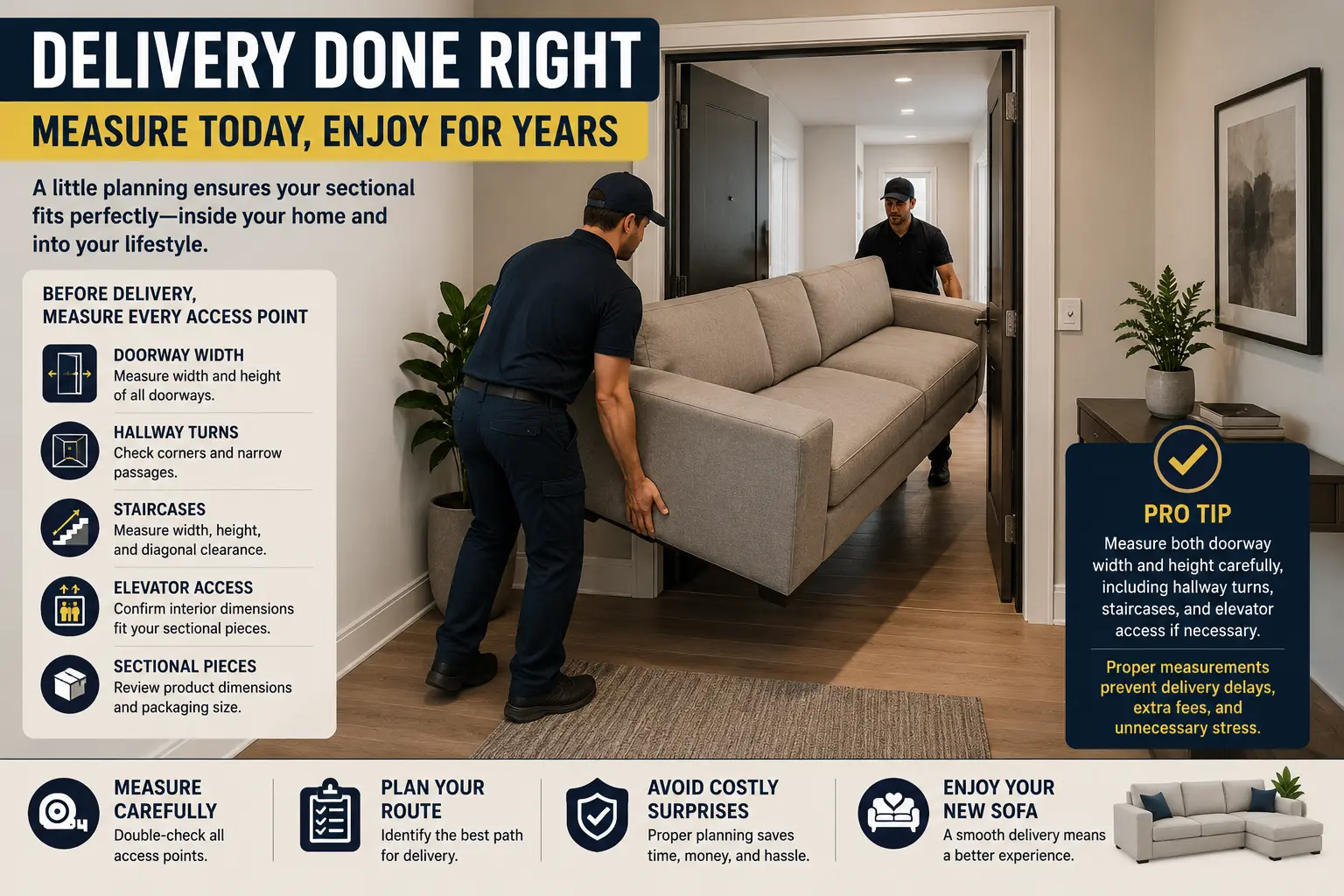
Pottery Barn’s measuring guide keeps it simple: measure the inside height and width of every doorway, staircase, elevator and hallway the couch will pass through, and note low-hanging fixtures and other architectural details along the way.
Step 1: Measure every opening on the route
Walk the path from the curb to the room. Measure the inside of each door frame, not the door itself, and write down the narrowest point. Check hallway width at any turn, the height above stair landings, and the inside of the elevator.
Step 2: Find the couch’s diagonal depth
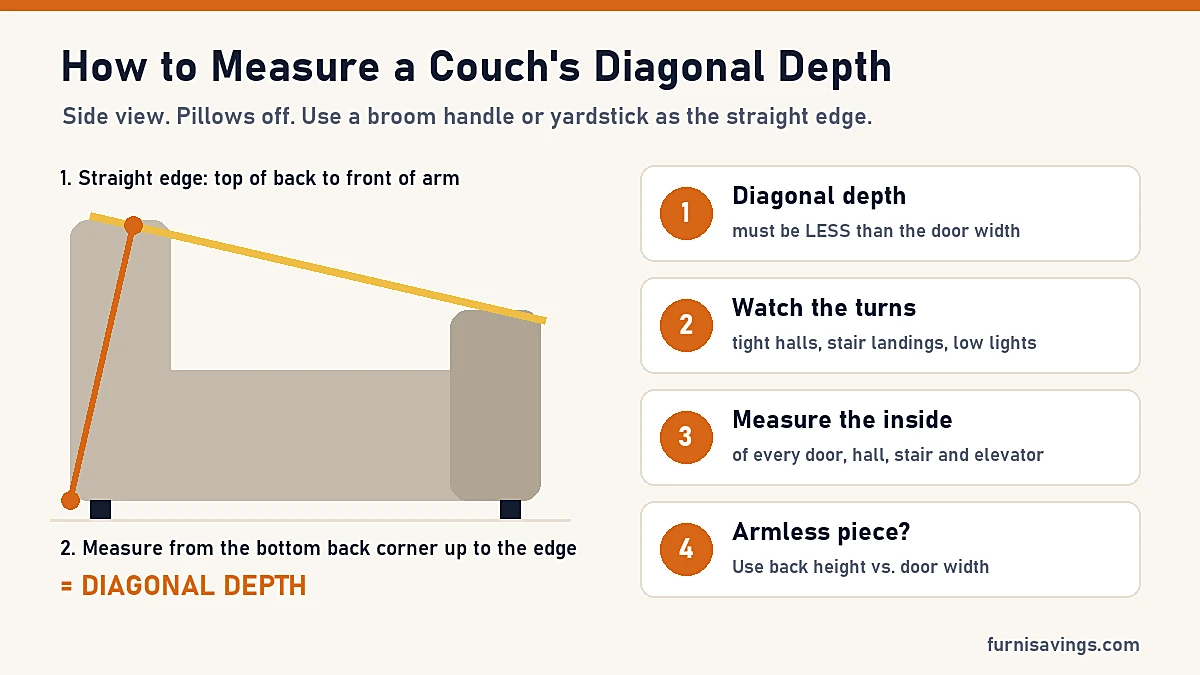
Diagonal depth is the number that decides whether a couch can tip through a door. According to the same guide, the diagonal depth must be less than the door width. For an armless piece, compare the back height to the door width instead.
To measure it on a couch you already have: take off the cushions and pillows, lay a straight edge (a broom handle or yardstick works) from the top of the back to the front of the arm, then measure from the bottom back corner up to that straight edge. If you’re buying online, look for the diagonal depth in the specs, or ask the seller before you order.
Step 3: Compare and leave room
Compare the diagonal depth with your narrowest door width. If the numbers are close, assume the couch won’t fit easily and plan on one of the fixes below, because fabric, door trim and hands all take up space. For room size, our sofa size calculator and sectional measuring guide cover the rest.
8 Fixes When Your Couch Won’t Fit
1. Remove the legs
Most couch legs screw off by hand. Taking them off can give you just enough clearance at the door or under a low frame. Put the screws in a bag and tape it to the couch.
2. Take the door off its hinges
An open door still takes up space in the frame. Tap out the hinge pins and lift the door away to use the full opening. Removing the doorstop trim can add a little more.
3. Change the angle
If your couch won’t fit flat, stand it on end or tip it on its back and “hook” it through the door, back first. This is exactly what the diagonal depth measurement is for.
4. Use a different entrance
Patio doors, back doors and garage entries are often wider or have an easier approach than the front door. If your couch won’t fit through the front, measure them too before you give up.
5. Take off removable parts
If the couch won’t fit in one piece, look for parts that come off. Some couches have arms or backs that unbolt, and sectionals come apart into pieces. Check the assembly instructions before you force anything.
6. Hire a furniture disassembly service
Some upholsterers and specialty services will take a couch apart, carry it in and rebuild it inside. It’s worth a call for a couch you love, though it can void a warranty, so check that first.
7. Return or exchange it
If nothing works, ask about a return or exchange right away. Read the policy first: big furniture often has restocking fees or return shipping costs, and some sale items are final sale. Our guide to spotting fake furniture sales covers what to check before you buy.
8. Choose a couch that comes in pieces
If your home has tight doors or stairs, a modular or boxed couch avoids the problem. Each section or box goes through on its own and you put it together inside. See our picks for the best modular sofas for apartments and the best sofas for small apartments.
How to Get a Couch Up Stairs (6 Steps)
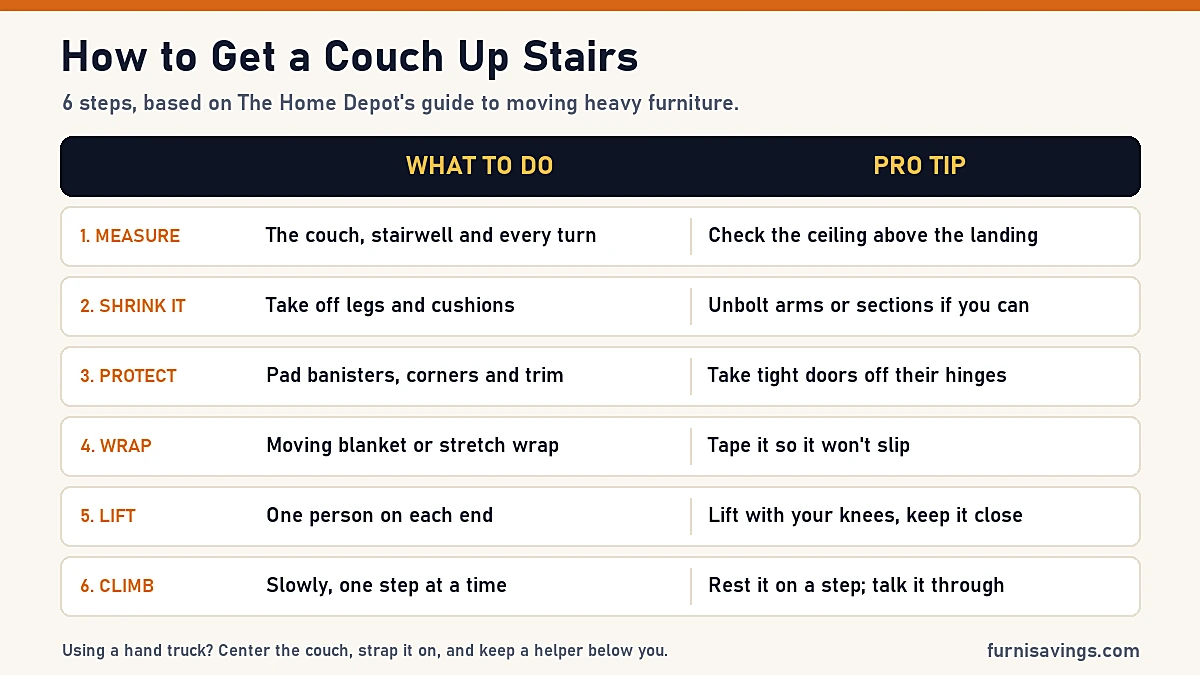
Stairs are where a couch is most likely to get stuck, or to damage your walls and your back. Here’s how to get a couch up stairs safely. The steps follow The Home Depot’s guide to moving heavy furniture, plus the measuring tips above.
1. Measure the stairwell and every turn
Measure the couch and every doorway and stairway on the route. On stairs, the tight spots are usually the turn at the landing and the ceiling above it, so measure those too. Compare them with the couch’s diagonal depth, as shown above. Our sectional measuring guide has more detail.
2. Make the couch smaller
Take off the legs and the cushions. If the arms or back unbolt, or it’s a sectional, take it apart. A lighter, smaller couch is far easier to turn on a landing.
3. Protect the stairs and walls
Cover banisters and corners with blankets or padding. At tight corners, take the door off its hinges or pad the trim so the couch doesn’t gouge it.
4. Wrap it for a better grip
Wrap the couch in a moving blanket or stretch wrap, and tape it so it won’t slip as you lift. Fabric and leather are hard to hold onto without it.
5. Lift with one person on each end
Don’t take a couch up stairs alone. You need a helper or two, with one person on each end. Lift with your knees, keep the couch close to your body, and agree on who calls the moves before you start.
6. Climb slowly and rest on the steps
Go up one step at a time. If you need a break, set the couch down on the stairs, and tell your helper before you do. If it won’t clear the landing, stand it on end and hook it around the turn, the same way you’d angle it through a door.
Using a hand truck on stairs
- Center the couch on the hand truck and strap it in place.
- Going up: roll the loaded hand truck backward to the stairs, stand on the first step with it leaning toward you, and pull it up one step at a time.
- Keep your helper below you the whole time, in case it rolls forward.
- Going down: stand behind the hand truck with the handles toward you, with your helper a few steps ahead.
When to call a pro
If the couch is too heavy or the stairs are too tight, many professional movers will come out to move just one piece. Home Depot also rents moving and lifting equipment. For your next couch, a modular sofa that comes in pieces avoids the problem.
How to Move a Couch Alone (On One Floor)
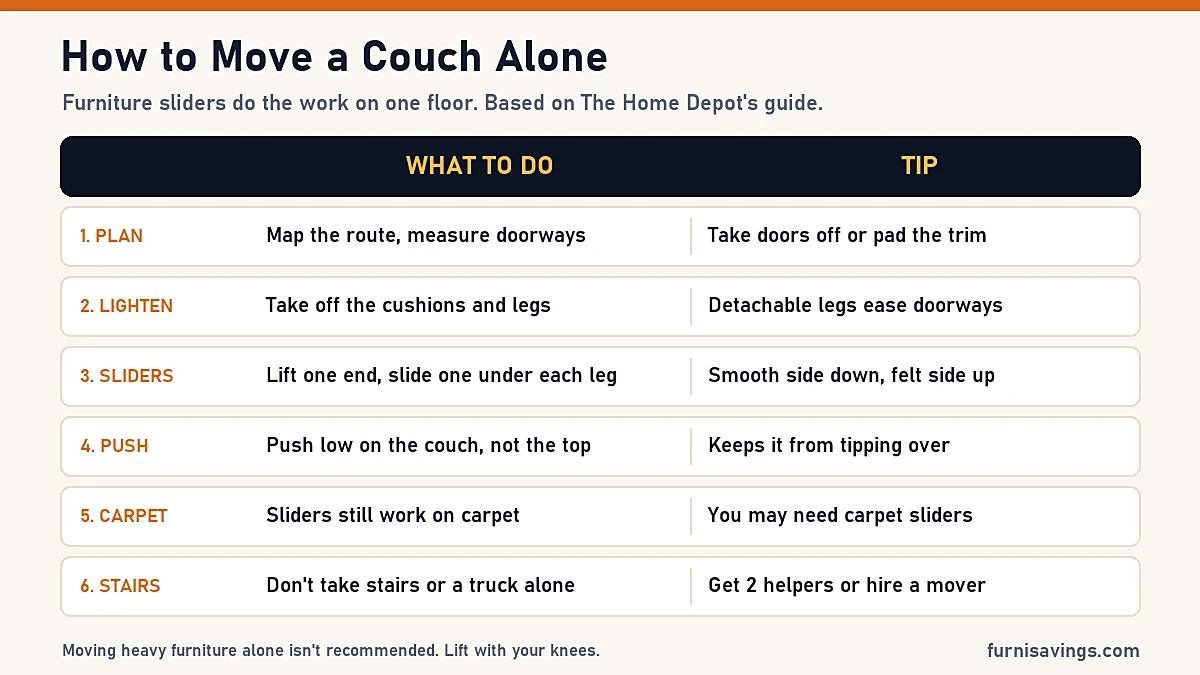
Need to move a couch by yourself, say to another room or across the living room? Furniture sliders make it doable. The Home Depot’s guide to moving heavy furniture recommends them especially when you’re moving heavy furniture on your own. It also says moving heavy furniture alone isn’t recommended, so keep solo moves to one floor and get help for stairs or a truck.
1. Plan the route
Measure the couch and every doorway it has to pass through, and clear the path. At tight corners, take the door off its hinges or pad the trim. If you’re not sure it will fit, check its diagonal depth as shown above.
2. Make it lighter
Take off the cushions and, if they unscrew, the legs. Without legs, the couch also gets through doorways more easily. For a move within the same house, you don’t need to wrap it.
3. Put a slider under each leg
Lift one end of the couch just enough to slide a furniture slider under each leg or corner, then do the other end. Put the smooth side on the floor and the padded felt side against the couch. Sliders also protect wood floors from scratches.
4. Push low, not from the top
Push from the lower part of the couch, not the top of the back. Pushing high can tip it over. Go slowly and steer around corners rather than forcing it.
5. On carpet, use carpet sliders
Sliders still work on carpet, but you may need ones made for carpet. If a slider catches, stop and reset it instead of shoving.
6. Get help for stairs and tight doorways
To get a loveseat through a narrow doorway, turn it on its side or hook it through: back it in, then rotate it so the other end follows. That’s easier with a second person. For stairs or loading a truck, get at least two helpers and follow the stairs steps above, or hire movers, since many will move a single piece.
What helps when you’re on your own
- Furniture sliders: the main tool for one-floor moves.
- A 4-wheel dolly: center the couch so it’s balanced, and strap it down.
- Lifting straps: useful once you have a helper.
- Good form: if you lift at all, lift with your knees and keep the load close to your body.
Which Fix Should You Try?
If your couch won’t fit, start with the free fixes and work down:
| Problem | Try first |
|---|---|
| Stuck at the door by an inch or two | Remove legs, take the door off its hinges |
| Wider than the door, even tipped | Different entrance, removable arms or back |
| Stuck at a hallway turn or stairs | Change the angle; ask the movers to stand it on end |
| Nothing works | Disassembly service, or return / exchange |
| Haven’t bought yet, tight home | Modular or boxed couch |
Shopping now? Black Friday is the busiest week for couch deliveries, so measure before the sales start. See this year’s Black Friday sofa deals and the best-selling sofas on Amazon.
Frequently Asked Questions
Measure the couch’s diagonal depth and the inside width of your narrowest door. Retailer guidance says the diagonal depth must be less than the door width. Also measure hallways, stairs and elevators along the route.
It’s the shortest distance from the bottom back corner of the couch to a straight edge laid from the top of the back to the front of the arm. It tells you whether the couch can tip through a doorway.
Remove the legs, take the door off its hinges, try a different angle or entrance, or remove detachable arms or backs. If none of that works, a disassembly service, a return, or a modular couch are the next options.
Sometimes. Some couches have arms or backs that unbolt, and sectionals separate into pieces. Some upholsterers also offer disassembly and reassembly, but it can void a warranty.
Modular and boxed couches, because each piece goes through the door on its own and you assemble the couch inside.
Measure the couch, the stairwell and the landing first. Take off the legs and cushions, pad the banisters and corners, and wrap the couch so it’s easy to grip. Then lift it with one person on each end, keep it close to your body, and go up slowly, one step at a time.
It isn’t safe. Home Depot’s guide says you need a helper or two on stairs, with one person on each end. Even with a hand truck, the helper stays below you in case it rolls. If you can’t get help, hire movers: many will move a single piece.
On one floor, yes. Put furniture sliders under each leg and push from the lower part of the couch so it doesn’t tip. The Home Depot says moving heavy furniture on your own isn’t recommended, so get at least two helpers for stairs or loading a truck.
Furniture sliders work on carpet too, but you may need sliders made for carpet. Lift one end, put a slider under each leg with the smooth side down, then do the other end and push from low on the couch.
More Sofa Guides
- How to fix sagging couch cushions.
- Ultimate sofa buying guide.
- Best time to buy a sofa.
- Furniture dimensions calculator.

Nayyar SK writes and updates the furniture reviews and buying guides on FurniSavings, covering sofas, bedroom sets, outdoor furniture and storage. Reviews are research-based, using product specs, verified-buyer reviews and current prices. See how we review furniture.